If your business ships, packs or handles dangerous goods by air, your staff must be trained and assessed as competent before they perform any dangerous goods function. Since 1 January 2023, that training must follow the competency-based training and assessment (CBTA) approach. CBTA isn’t unique to IATA: it’s the approach set out by ICAO in the Technical Instructions (Part 1, Chapter 4) and reflected in Subsection 1.5 of the IATA Dangerous Goods Regulations (DGR). This guide is for business owners and managers. It explains what CBTA means, what it does for your business, what you are responsible for, and how an outside provider can help.
In short: CBTA is the approach dangerous goods training for air transport must follow. Training is built around the functions each person performs and the competencies they need, and each person is assessed against defined performance criteria to confirm they can perform those functions to the required standard.
What is CBTA?
CBTA stands for competency-based training and assessment. It is the approach required by the ICAO Technical Instructions and reflected in the IATA DGR for dangerous goods training in air transport. Under CBTA, personnel are:
- Trained in the knowledge, skills and attitudes their assigned functions require. What a person needs depends on the dangerous goods functions they perform, such as classifying, packing, marking and labelling, completing the Shipper’s Declaration, or accepting cargo. It does not depend on their job title.
- Assessed against defined performance criteria. Assessment confirms each person can perform their functions competently. It can take place during training as well as afterwards.
The training is targeted. A training needs analysis identifies what each person’s functions require, and that shapes the content, depth and delivery of their training. This doesn’t mean a separate bespoke course for every person: people can share common courses and modules where these meet their identified needs. What matters is that each person’s training and assessment covers the functions they actually perform and the competencies they need.
For example, a warehouse operative who packs and labels lithium battery shipments and an administrator who prepares the shipping paperwork perform different functions, so their training and assessment will cover different things, even if they share some modules. The same goes for everyone else involved: what they need depends on their actual functions, not their title. Signing a Shipper’s Declaration, for instance, is a dangerous goods function with its own training needs, while general managerial oversight of a team is a different responsibility.
The CBTA guidance from ICAO (Doc 10147) and IATA defines competency as “a dimension of human performance that is used to reliably predict successful performance on the job”. In practice, competency combines knowledge (understanding the rules), skills (being able to apply them) and attitudes that support safe and compliant performance.
The previous category-based framework already required training appropriate to each person’s responsibilities, with testing to confirm understanding. CBTA builds on that by starting from the functions people perform and assessing them against defined performance criteria:
| Aspect | Previous category-based framework | CBTA approach |
|---|---|---|
| Starting point | Personnel categories and prescribed subject coverage | Assigned functions, tasks and required competencies |
| Training design | Relevant subjects selected using category tables | Training needs analysis informs content, depth and delivery |
| Assessment | Testing to confirm understanding | Assessment against defined performance criteria |
What are the benefits of CBTA?
CBTA helps reduce errors and rejected shipments, and focuses training time on what each person actually needs. IATA’s guidance highlights these benefits:
- Better-targeted training time. The training needs analysis focuses content and depth on each person’s functions, rather than on a fixed list of subjects.
- Clear expectations. Each employee knows which functions they are responsible for and the performance standard expected of them.
- Fewer rejections and delays. Training focused on the functions people actually perform helps reduce shipments that are rejected, held up or slowed by improper preparation or documentation. Something as small as a Cargo Aircraft Only label on the wrong face of a package can be enough for it to be turned away.
- Improved safety. People who have been trained and assessed as competent for their functions are less likely to make mistakes.
What is the employer’s role?
The employer remains responsible for ensuring personnel are competent to perform their assigned functions, even when training and assessment are outsourced. IATA’s guidance sets out five phases for developing and implementing a dangerous goods CBTA programme, based on the ADDIE model: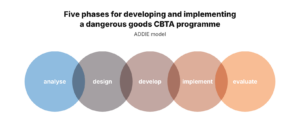
- Analyse. Identify the dangerous goods functions each person performs, the tasks involved and the competencies required, taking into account the regulations, your own procedures and your staff’s existing knowledge, skills and attitudes. This is the training needs analysis (TNA).
- Design. Prepare a training plan (what is taught, how and when) and an assessment plan (how competence will be measured).
- Develop. Produce the training materials, practical exercises and assessment tools.
- Implement. Deliver the training and assessments, and provide additional training and support to anyone not yet assessed as competent.
- Evaluate. Check that the programme is working, using assessment results, audits, incident reports and feedback, and adjust it where needed.
Employers must also:
- Ensure personnel are trained and assessed as competent before performing their assigned functions.
- Provide recurrent training and assessment within 24 months of the previous training and assessment. If it is completed within the final three months before it falls due, the existing expiry cycle is preserved.
- Retain training and assessment records for at least 36 months from the most recent training and assessment completion month, and make them available on request to the employee or the appropriate national authority.
- Make sure training includes general familiarisation, function-specific and safety training, together with relevant company procedures.
- Assess competence when personnel move to new functions, and provide additional training where needed.
How can a third-party CBTA provider help?
A third-party provider can support any or all of the five phases, but the employer remains responsible for ensuring personnel are competent to perform their assigned functions. IATA’s guidance confirms that employers can outsource the full programme or only specific courses, especially when they lack the in-house resources or expertise.
A provider can:
- Carry out the training needs analysis, matching each role to its dangerous goods functions.
- Design and develop training and assessment plans tailored to your operation.
- Deliver training in whatever format suits your teams: classroom, virtual classroom, eLearning or a blend.
- Carry out competency assessments against defined performance criteria and provide the records.
- Evaluate the programme, audit how it works in practice, and help you keep records ready for inspection.
- Provide ongoing expert support when questions come up between training cycles.
Trident Safety Group has supported businesses with dangerous goods compliance since 1990. Our team can help you through the CBTA process, from the training needs analysis to competency assessment and ongoing evaluation.
Are there prerequisites before someone can start training?
It depends on the course. A training needs analysis considers each person’s existing knowledge, skills and attitudes and identifies the training they require.
Some courses do have entry requirements. For example, IATA’s recurrent acceptance course requires a valid relevant certificate. New starters receive initial training and are assessed as competent before they perform any dangerous goods function.
Experienced staff may not need to repeat content they have already shown competence in, but that is for the training needs analysis to decide; it isn’t automatic. Their training and assessment must still cover the functions they perform and the competencies they need to maintain.
Frequently asked questions about CBTA
Is CBTA mandatory?
Yes, for dangerous goods by air. The revised training and assessment provisions became mandatory on 1 January 2023 under the ICAO Technical Instructions (Part 1, Chapter 4) and IATA DGR Subsection 1.5.
Does CBTA apply to road and sea transport?
The CBTA framework described here applies to air transport. Road (ADR) and sea (IMDG Code) have their own training requirements in Chapter 1.3 of each, and these already require function-specific training appropriate to each person’s duties. Air CBTA doesn’t replace those requirements: if your staff work across modes, each mode’s requirements apply.
How often is CBTA training and assessment needed?
Recurrent training and assessment remain required within 24 months of the previous training and assessment, and must address the functions personnel perform and the competencies they need to maintain. When someone moves to new functions, their competence must be assessed for those functions, with additional training where needed.
Can CBTA training be delivered online?
Yes. Training can be delivered in a mix of formats, such as classroom, virtual classroom and eLearning, depending on what the training needs analysis identifies. Assessment must be against defined performance criteria, using methods suited to the competencies being assessed.
How long must CBTA records be kept?
At least 36 months from the most recent training and assessment completion month. They must be available on request to the employee or the appropriate national authority.
Need help with CBTA?
Whether you need a full CBTA programme or help with a single stage, such as a training needs analysis or competency assessments, Trident can help. Talk to our team about your operation and the roles involved.
Contact us today. We look forward to helping you with your compliance needs.