
You probably have them somewhere: a box of lithium battery stickers in the store’s cupboard. Maybe they were bought in bulk. Maybe there are preprinted cartons sitting on a rack, or perhaps the phone number is built into a label template that nobody has looked at in years.
The problem is that, from 1 January 2027, that phone number can no longer appear inside the battery mark.
So if you have old stock sitting around, now is the time to use it.
What actually changes?
From 1 January 2027, the battery mark must no longer include a telephone number.
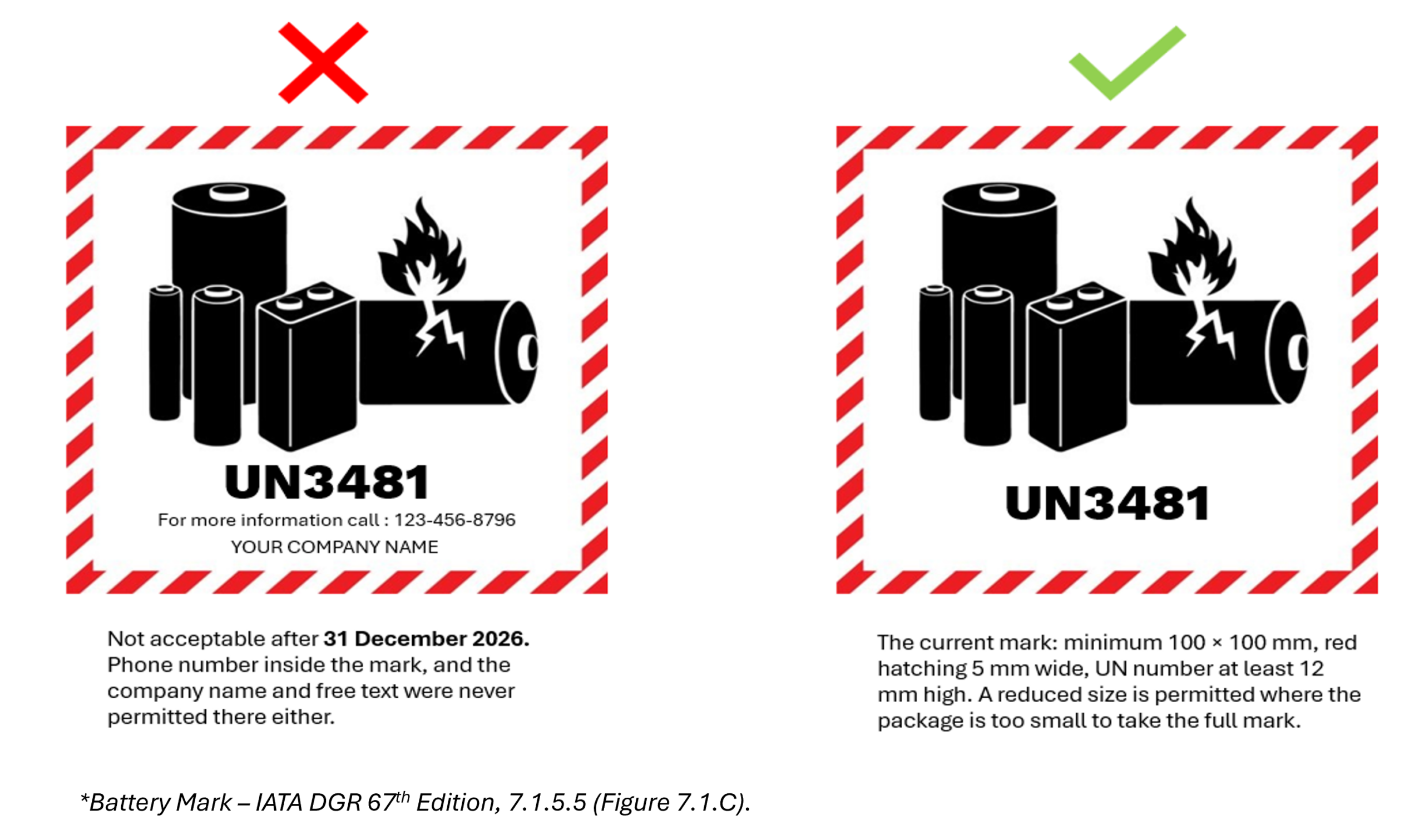
It sounds like a small change, but these are often the changes that get missed. The old labels can still be sitting in the store’s cupboard, built into a printer template, tucked away in the WMS, or showing up in training material months after everyone has moved on.
But ADR gives us six months, doesn’t it?
Usually, yes.
ADR 2027 comes into force on 1 January, with the usual transitional arrangements allowing ADR 2025 to continue until 30 June 2027
But that does not extend the transition period for the battery mark.
The mark had its own specific transitional deadline: 31 December 2026.
So from 1 January 2027, air, sea and road all arrive at the same point. There is no extra six-month buffer for this particular change.
Why was the phone number removed?
The short answer is: nobody was getting much practical value from it.
- What was the number actually for?
- Was someone expected to answer at 3am?
- Was it an office-hours number?
- Did it need to reach someone who understood batteries?
- Was a company switchboard acceptable?
There were plenty of different interpretations.
In April 2020, PRBA and RECHARGE raised the issue with the UN, arguing that after years of use, the telephone number wasn’t providing much practical benefit.
The UN agreed and gave shippers time to use the labels they had already purchased.
The transition period runs until 31 December 2026.
Where are the old marks likely to be hiding?
Most companies won’t run into problems because nobody knew about the change.
They’ll run into problems because the old mark is still sitting somewhere in the process.
1. Your WMS or label-printing template
The phone number may be hard-coded into a template created years ago.
The person who created it may have left. The file may now sit with IT, even though nobody in IT knows it’s a regulatory document. This is probably one of the harder things to change because it can easily fall between departments.
2. Preprinted cartons
If the battery mark is already printed on the carton, check your remaining stock. Those cartons don’t become compliant because they were purchased before the deadline.
3. The stores cupboard
This is the obvious one. Open the cupboard and count the old labels.
4. Supplier or inbound goods
Some products may arrive with the battery mark already applied by your supplier.
If you’re subsequently re-exporting the package, don’t assume the supplier’s mark makes it your problem to ignore. Check what you’re actually putting into transport.
The ten minutes of self-audit
Give these five questions to your team:
- How many old-format labels are currently in the stores cupboard?
- How many preprinted cartons have the old mark already applied?
- Does your current label-printing template contain the phone number? Who owns that template?
- Which suppliers are sending you goods with the battery mark already applied?
- Does your current DG training material still show the old mark?
Five questions. Ten minutes.
You’ll have a much better idea by lunchtime whether you have a January problem.
Frequently asked questions
Can I just cover the phone number with a sticker?
No. An outdated mark shouldn’t simply be patched over and left partially visible. The old information needs to be properly removed or the package needs the correct mark.
And from a practical point of view, a visibly patched label is likely to attract more attention during acceptance.
Do I still need an emergency contact number?
Yes. The emergency contact information doesn’t disappear completely.
It just doesn’t belong inside the battery mark.
Check your transport documentation and SDS requirements, and remember that a telephone number is not automatically required on transport documentation unless specifically called for by the applicable regulations, State Variations or operator requirements.
What about stock that is already in transit on 31 December?
Fine. The transitional period applies at the point the package is offered for transport, so a consignment lawfully accepted before the deadline doesn’t become non-compliant in transit.
What isn’t covered is stock you marked early and haven’t shipped – that’s inventory, not transit, and from 1 January 2027 it will need the new mark.
I have got a lot of old labels sitting here. What do I do with them?
For transport after 1 January 2027, don’t rely on the old-format stock. The transition period was there to give companies time to use existing stock. If you still have a large quantity at the end of the year, you may need to write it off.
How much new label stock should I order?
Base it on actual consumption, not the deadline. Look at what you actually use each month and order accordingly.
Does this affect our DG training records?
Yes. If your training material still shows the old battery mark, it needs to be updated.
Three questions can tell you whether you have a problem
If you’re not sure where you stand, start with these three numbers:
1. How many old-format labels do you have right now?
2. How many do you normally use in a month?
3. How many different UN numbers do you regularly mark?
That third question is important. You may not have one lithium battery label to replace.
You could be dealing with UN3480, UN3481, UN3090, UN3091, as well as the newer sodium-ion battery numbers.
So check the whole set rather than assuming you’ve solved the problem because you’ve replaced one label.
How Trident can help
If you find old stock during your check, Trident can help you replace it without over-ordering.
Compliant marks, ready to ship
New-format labels for the UN numbers you actually use, including UN3480, UN3481, UN3090, UN3091 and sodium-ion battery numbers, are held in stock so you’re not waiting for a print run in December.
No minimum order
Order based on what you actually use. You don’t need to fill your stores cupboard just because a regulatory deadline is approaching.
BS 5609-durable and suitable for multiple modes
Designed for durability in demanding transport conditions, these labels are made to withstand the handling and environmental exposure that comes with air, sea and road transport. One durable label solution, without needing separate stock for different journeys.
Custom and bespoke printing
Different sizes, materials and combined marks can be produced to suit your packaging and your operation.
DG training that matches the label
Your physical labels and your training material should tell the same story.
If your course still shows the old mark, we’ll help bring the training material up to date too.
A second pair of eyes on your stock
Tell us:
- what old-format stock you have,
- roughly how much you use each month, and
- which UN numbers you work with.
We’ll help you work out whether you have a January problem or whether you’re already in good shape.
No charge.
Don’t wait until the first shipment gets stopped
The change itself is simple.
The difficult part is finding every place the old mark has worked its way into your operation.
Check the cupboard. Check the cartons.
Check the printer template.
Check your suppliers.
And check the training material.
Do it now, while you’ve still got time to fix what you find.
Contact us today, we look forward to helping you with your compliance needs.
Source: UN document ST/SG/AC.10/C.3/2020/48