
Dangerous goods found in the wild, and the regulations they miss
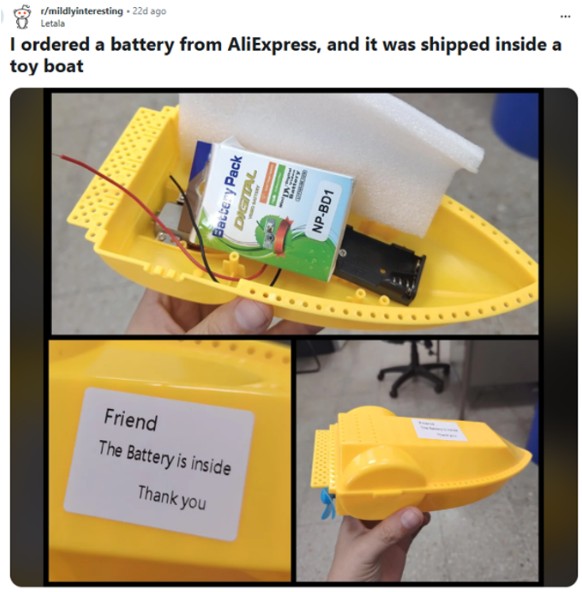
Image source: r/mildlyinteresting via reddit
I spend a lot of my working life with the lithium battery transport regulations, which has made me far more aware of batteries outside the workplace too. Last week, something on Reddit caught my eye.
Someone on r/mildlyinteresting had ordered a digital camera battery from AliExpress. Instead of a battery in a box, they received a toy boat. There was no sign of the battery — until they pulled apart the two halves of the boat and found it sitting inside. The comments were split: some thought it was a strange marketing gimmick; others recognised it for what it probably was — an attempt to exploit a loophole in the air transport rules for lithium batteries.
Surely not, I thought. Surely it doesn’t take so little to get around the rules. That’s what sent me back to the regulations, to see whether this loophole was real.
Investigating the loophole
A lithium-ion battery shipped on its own travels as UN3480. A lithium-ion battery packed with, or contained in, equipment travels as UN3481. There’s a strong incentive to ship goods as the latter, because a standalone UN3480 battery is forbidden as cargo on passenger flights. Shipping it can take longer and be more operationally demanding and expensive. A battery contained in equipment, by contrast, can travel on a passenger aircraft — and, in the right circumstances, under far lighter requirements.
The trick seems obvious: take a battery that should be UN3480, put it inside something, and present it as UN3481. Hence a battery shipped inside a toy boat.
It turns out the loophole doesn’t hold up. It fails for two separate reasons: one in how the regulations define “equipment,” and a second in how the battery has been packaged.
Why it isn’t “contained in equipment”
Let me give the shipper their best case first.
The battery is genuinely, physically inside a toy boat. The battery is contained, the boat is a manufactured device, and UN3481 under Packing Instruction 967 covers batteries contained in equipment. On the surface, it seems like this is a valid, exploitable loophole.
However, PI967 defines equipment as ‘the device or apparatus that the lithium cells or batteries will provide electrical power for its operation.’ The camera battery does not power the toy boat and it was never meant to. The boat is a container of convenience, chosen because a battery happens to fit inside it. Under the regulatory definition, the boat therefore isn’t “equipment” for this battery at all.
And then there’s the packaging, which is where things start to look dangerous. Several problems are visible at a glance:
- The outer packaging is ordinary printed retail cardboard, not the strong, rigid outer packaging the rules call for. Cardboard of this kind almost certainly will not protect the battery as it moves through the transport chain.
- The cushioning is minimal and the battery is free to move, leaving it exposed to impact in transit. Rough handling could damage the cell and, in the worst case, trigger a short circuit or thermal runaway.
- There are exposed metallic components inside the boat. Batteries have to be protected against short circuit, including by keeping them away from conductive material — and a loose battery bouncing around beside bare metal is a short circuit waiting to happen.
Conclusion
The concealment is a problem on its own. The battery almost certainly shipped with no Class 9 label, no lithium battery mark, and no Cargo Aircraft Only label. It is undeclared dangerous goods — an offence in itself, and probably the most serious one here.
If this is a routine tactic among high-volume overseas sellers, then a large and largely invisible flow of undeclared batteries is entering the air cargo system. No enforcement regime can inspect every low-value parcel, so the more useful response is education rather than enforcement.
Someone who tries this usually sees only the cost and paperwork of shipping a battery properly, not the reason the rules exist. A shipper who understood that lithium batteries can catch fire in transit, and who knew that a concealed battery is still a standalone battery, would have far less reason to look for a way around the rules. Getting the classification right is the shipper’s responsibility, and better awareness of both the risk and the rules is what will bring down cases like this.
We’re experts in the transportation of dangerous goods. Whether you need support with DG compliance or are looking to enhance your knowledge, we’re here to help.
Contact us today for all your Dangerous Goods (DG) compliance needs, or enrol in our comprehensive Battery Training Course to stay compliant and confident.